

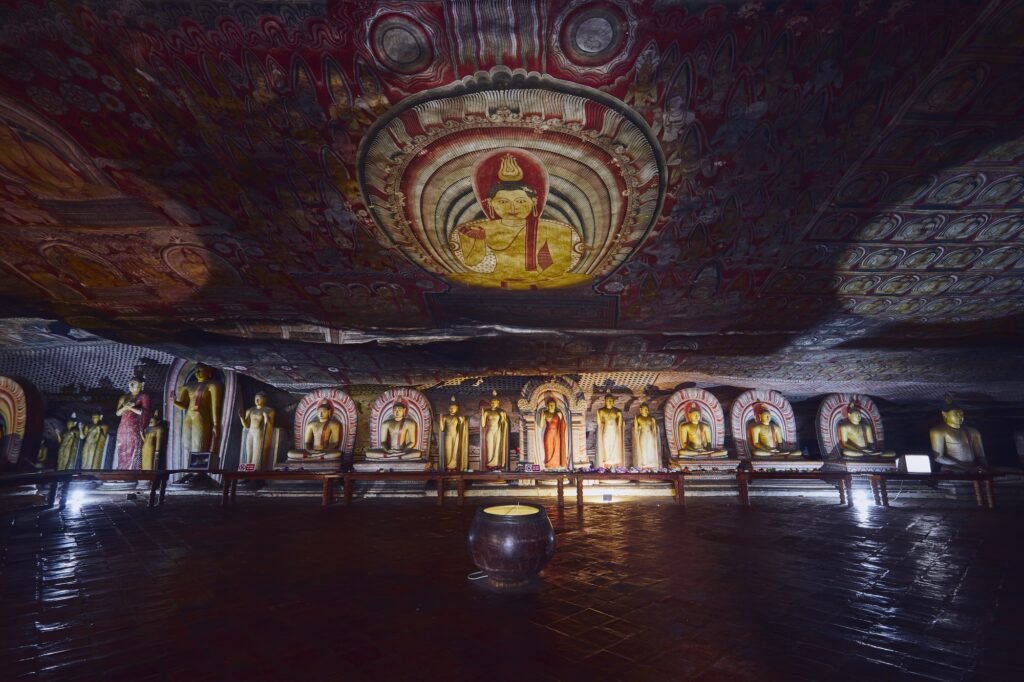
Nestled within a massive granite outcrop, the Dambulla Royal Cave Temple—often referred to as the Golden Temple—is a profound masterpiece of ancient architecture and spiritual devotion. As a revered UNESCO World Heritage site, it has served as a sanctuary for pilgrims, royalty, and travelers for over 2,000 years. This site is not merely a collection of caverns; it is a living gallery where history, art, and faith converge in the very heart of Sri Lanka’s cultural landscape.
Stepping into these cool, dimly lit caves is like traveling back in time. You will walk through spaces once inhabited by ancient monks and refuge-seeking kings, surrounded by murals that have stood the test of centuries. This guide provides an immersive look into the site’s legendary past and offers practical advice to help you navigate this iconic spiritual landmark with ease.
The Historical Legacy of Dambulla
The story of Dambulla begins in the first century BC, a time of political upheaval in the Anuradhapura Kingdom. When King Valagamba was ousted by foreign invaders, he found sanctuary in these dense forests and hidden rock shelters. For over fourteen years, these natural caves provided him with a safe haven.
Upon regaining his throne, the King expressed his gratitude by transforming these rugged shelters into a grand Buddhist temple, commissioning the very first rock statues and murals. Over the following centuries, this project became a labor of love for generations of rulers. Kings of the Polonnaruwa and Kandyan dynasties continued the work, gilding statues and restoring vibrant paintings that remain visible to this day, showcasing a unique evolution of Sri Lankan artistic style.
A Journey Through the Five Sacred Caverns
The temple complex features five distinct caves, each housing a remarkable collection of over 150 Buddha statues, royal figures, and deities. Every wall and ceiling is meticulously painted with scenes reflecting the Buddha’s life, creating an atmosphere of intense artistic beauty.
The Cave of the Divine King (Devaraja Lena)
The first stop, the Cave of the Divine King, is anchored by a massive 14-meter-long reclining Buddha statue carved directly from the granite. The statue marks the Buddha’s peaceful transition into Nirvana, and the surrounding artistry, including a statue of his disciple Ananda and a shrine to Vishnu, highlights the inclusive nature of the island’s ancient spiritual traditions.
The Cave of the Great Kings (Maharaja Lena)
As the largest cave in the complex, the Maharaja Lena is truly majestic. Named for King Valagamba and King Nissanka Malla, this vast space is famous for its semi-circle arrangement of statues and a mysterious, sacred spring on the ceiling that drips water continuously, even during the driest seasons.
The Great New Monastery (Maha Alut Viharaya)
Constructed in the 18th century, this cave reflects the peak of Kandyan-style artistry. Inside, fifty Buddha statues stand in serene rows under a ceiling covered in impeccably preserved murals featuring rich blacks, bright yellows, and deep reds.
The Western Cave and The Second New Temple
The final two caves—the Pachchima Viharaya (Western Cave) and the Devana Alut Viharaya (Second New Temple)—provide a more intimate atmosphere. Featuring seated Buddhas under intricate floral archways and restored 20th-century artwork, these spaces perfectly round out the spiritual journey through the hillside.
Expert Tips for a Seamless Experience
To fully enjoy your visit, keep these practical logistics in mind:
- Timing Matters: Avoid the midday heat and the largest tour groups by arriving early in the morning or during the late afternoon.
- Dress Modestly: Because this is an active religious site, you must cover your shoulders and knees. Carry a sarong in your bag for easy compliance.
- Protect Your Feet: The stone courtyard can become scorching hot under the tropical sun. Pack a pair of thick socks to wear while walking barefoot across the temple grounds.
- Respect the Space: Photography is allowed, but strictly no flash. Furthermore, never stand with your back to a Buddha statue; always position yourself sideways when taking photos.
- Mind the Wildlife: The resident macaque monkeys are very clever. Keep all snacks securely hidden in a zipped bag to avoid unwanted attention from them.
What to Bring in Your Daypack
Pack light but effectively to ensure a comfortable climb and exploration:
- Hydration: Carry plenty of water to manage the humidity and the 20-minute climb.
- Sun Protection: A hat and high-SPF sunscreen are essential for the exposed sections of the staircase.
- Cover-ups: A large scarf or sarong for temple entry.
- Socks: A thick pair to navigate the hot stone floors comfortably.
Conclusion
The Dambulla Royal Cave Temple is a testament to human resilience and religious fervor. Whether you are moved by the colossal stone carvings, the delicate ceiling murals, or the panoramic views of the surrounding plains—including a distant look at Sigiriya—this site offers a rare connection to the soul of Sri Lanka. A visit here is not just an excursion; it is a meaningful encounter with history that will linger in your memory long after you depart.